
 Available in US
What Australians Can Legally Bet On—and What They Cannot
The legal boundary around gambling in Australia is easy to blur because the word betting covers several different activities. A licensed wager on a sporting event sits on one side of that boundary. A real-money online casino sits on the other. Treating them as interchangeable is not a harmless shortcut: the licensing system, the applicable law and the regulator’s powers are different.
Australia has no single gambling statute and no single gambling authority governing every form of gambling nationwide. Responsibility is divided between the federal government and the states and territories. That arrangement reflects the country’s political structure, but it also creates a market in which the same broad word—gambling—can conceal very different legal categories.
For online services, the federal Interactive Gambling Act 2001 supplies the central restriction. State and territory authorities remain important because wagering licences are issued and administered at that level. The result is not a general permission to gamble online, but a narrower legal channel for particular products.
This index highlights online casino operators for Australian players, with attention to the licensing, bonuses, payment speeds, and minimum deposits stated for each brand. Use the individual verdicts as a quick reference when reviewing the available options.
License: Curacao eGaming Licence · Min. deposit: A$10 Rocket Play operates under a Curacao eGaming Licence and accepts deposits from A$10. It may suit players looking for a low minimum deposit and a clearly stated licence.
License: Tobique Gaming Commission · Bonus: up to A$8,000 + 400 free spins across 4 deposits · Payout speed: crypto ~10-15 minutes, fiat 1-5 days · Min. deposit: A$30 SkyCrown stands out for a bonus of up to A$8,000 plus 400 free spins across four deposits. Crypto payouts are listed at around 10–15 minutes, while fiat payouts take 1–5 days; the minimum deposit is A$30.
License: Curacao eGaming Licence · Min. deposit: A$10 PlayWest holds a Curacao eGaming Licence and has a minimum deposit of A$10. Its key appeal is a low entry requirement combined with a stated licence.
License: Curacao eGaming (Dama N.V.) · Bonus: up to A$10,000 + 180 free spins, 40x wagering JeetCity Casino operates under a Curacao eGaming licence through Dama N.V. Its offer includes up to A$10,000 plus 180 free spins, with 40x wagering.
License: Curacao, operated by Dama N.V. · Bonus: 325% up to 5.25 BTC + 250 free spins across 4 deposits 7Bit Casino is operated by Dama N.V. under a Curacao licence. Its promotion reaches 325% up to 5.25 BTC plus 250 free spins across four deposits.
License: international iGaming licence – jurisdiction not named in the source · Bonus: 100% up to A$1,000 + 100 free spins, 35x wagering · Payout speed: PayID 1-24 hours · Min. deposit: A$30 (PayID from A$10) House of Pokies lists an international iGaming licence, although the jurisdiction is not named in the source. It offers 100% up to A$1,000 plus 100 free spins with 35x wagering, while PayID payouts are stated as taking 1–24 hours.
License: Curacao · Bonus: 100% up to A$500 + 200 free spins, 10x wagering · Payout speed: crypto 30-60 minutes, fiat 1-5 days · Min. deposit: A$10 Wild Tokyo operates under a Curacao licence and offers 100% up to A$500 plus 200 free spins with 10x wagering. Crypto payouts are listed at 30–60 minutes, fiat payouts at 1–5 days, and the minimum deposit is A$10.
Bonus: up to A$750 + 50 jackpot spins, 35x wagering · Payout speed: crypto ~90 minutes, fiat 1-5 days · Min. deposit: A$30 Kingmaker features a bonus of up to A$750 plus 50 jackpot spins, with 35x wagering. Crypto payouts are listed at around 90 minutes, fiat payouts at 1–5 days, and the minimum deposit is A$30.
Bonus: up to A$6,600 + up to 250 free spins across 4 deposits DragonSlots Casino is notable for a bonus of up to A$6,600 plus up to 250 free spins across four deposits. These promotional terms are the main stated feature for this operator.
License: Curacao · Bonus: up to A$10,000 multi-stage + 500 free spins · Min. deposit: A$20 (POLi) Lucky Dreams operates under a Curacao licence and offers a multi-stage bonus of up to A$10,000 plus 500 free spins. The minimum deposit is A$20 when using POLi.
The permitted online category
Online sports betting is legal in Australia when supplied through operators holding the relevant state or territory licences. Race wagering belongs to the same permitted category. The licence is not a decorative badge attached to a website; it is the legal basis on which the service may accept wagers from Australian residents.
This distinction matters because a service can look commercially similar to another service while having a completely different legal status. Both may display odds, accept deposits and settle outcomes online. One may be authorised to offer sports or race wagering. The other may be offering a product that Australian law treats as prohibited.
The lawful category is therefore defined by both the activity and the licence behind it. A sports-betting licence does not become a casino licence merely because the same brand, app or account also appears to offer casino-style games. Australian licensing does not work by association.
Lotteries are also licensed in Australia, although they are a separate category from sports and race wagering. They should not be folded into a general assumption that every online gambling product is available simply because some forms of wagering are lawful.
What the federal law prohibits
The Interactive Gambling Act 2001 makes it illegal for gambling providers to offer certain online services to people in Australia. Online casino games fall within that prohibited category. This includes pokies, roulette, blackjack and live dealer tables when offered online to an Australian customer.
The legal issue is the provision of the service, not the popularity of the game. A familiar casino format does not acquire a domestic licence merely because it has been played in Australia in other settings. Nor does an online version become lawful because the website is operated from another country or uses a foreign regulatory framework.
There is no domestically licensed real-money online casino for Australian players. No Australian gambling licence exists for casino games because offering that product to Australians is against the law. In practical terms, the market has a licensed online wagering lane, but no equivalent domestic online-casino lane.
Prohibited Services Online casino games, including pokies, roulette, blackjack, and live dealer tables, are prohibited interactive gambling services for Australian customers.
That is the point at which many casual comparisons go wrong. They place a bookmaker and an offshore casino in the same table and describe both as “licensed operators”, as though a licence were a universal passport. It is not. A licence has a jurisdiction, a product scope and a legal purpose. Remove those three details and the word becomes little more than packaging.
Who enforces the boundary?
The Australian Communications and Media Authority, or ACMA, monitors compliance with and enforces Australia’s interactive gambling laws. Its role is federal, even though gambling regulation more broadly is shared across jurisdictions.
ACMA also publishes a register of Australian-licensed interactive wagering service providers. That register is relevant to the lawful wagering market: it concerns Australian-licensed interactive wagering services, not a domestic register of online casino providers. Since no Australian casino licence exists, the absence of casino names is not a gap waiting to be filled. It is part of the legal structure.
ACMA’s enforcement tools include directing internet service providers to block sites operating in breach of the Interactive Gambling Act. Site blocking does not turn an offshore service into an Australian-licensed one, nor does it redraw the boundary between lawful wagering and prohibited casino provision. It is an enforcement response to the boundary already established by law.
The arrangement can seem unusually fragmented. State and territory regulators deal with licensing for permitted forms of wagering, while ACMA enforces the federal interactive-gambling restrictions. There is no single national gambling authority that issues one universal licence for every product. That absence is not a technical footnote; it explains why a claim about “Australian licensing” must always specify what is licensed and under which jurisdiction.
Provider responsibility is not the same as player responsibility
The Interactive Gambling Act targets the provider rather than the player. Australians are not committing a crime merely by placing bets at offshore sites. That fact should be stated precisely, because it is often distorted in both directions.

It does not mean that offshore casino services are legal or licensed for Australian customers. They are not. It means that the statutory focus is on the provider offering the prohibited interactive gambling service, rather than making the individual customer a criminal for placing a bet.
That distinction offers no domestic licence where none exists. It also does not create the consumer protections associated with an Australian-licensed wagering service. Legal exposure, regulatory status and practical safety are separate questions, even when websites present them as one reassuring label.
A working boundary for Australian gambling content
The simplest way to read the market is to separate the product first and the website second.
- Sports betting may be offered online when the operator holds the relevant Australian state or territory licence.
- Race wagering may be offered online within the applicable licensing framework.
- Lotteries form another licensed gambling category.
- Online casino games, including pokies, roulette, blackjack and live dealer tables, are prohibited interactive gambling services when offered to Australian customers.
- No domestically licensed real-money online casino exists for Australian players.
This is not a recommendation list. It is a legal map.
The map also explains why the phrase “casino licence” requires caution in an Australian context. A foreign operator may hold authorisation from a regulator outside Australia, but that foreign authorisation does not become an Australian gambling licence and does not authorise the provision of online casino games to Australian customers. The domestic question comes first.
For the same reason, general advice to “choose a licensed casino” is misleading here. There is no Australian casino licence to choose. The lawful Australian online market is narrower: sports and race wagering, under the relevant licensing arrangements. Everything discussed later—games, commercial offers, payment questions or comparison claims—has to be read against that boundary.
The law is not a menu. It is a border.
Pokies and Casino Games Behind the Legal Line
In Australia, the word casino carries a legal complication that is easy to miss in casual conversation. It suggests a familiar group of games: pokies glowing in a club corner, roulette turning under a croupier’s hand, blackjack dealt across green baize, and the increasingly polished theatre of live dealer tables. In a physical venue, these games belong to a long-established gambling culture. Online, offered to an Australian customer, they occupy a different category altogether.
Electronic gaming machines that are prohibited when offered as an online interactive service to Australians.
Traditional casino games that remain illegal in the online interactive format under the Interactive Gambling Act.
Real-time streamed games that carry the same legal prohibition as automated online casino software.
Under the Interactive Gambling Act 2001, online pokies, roulette, blackjack and live dealer tables are prohibited interactive gambling services. The distinction is not about whether the game is recognisable, entertaining or operated from a sophisticated website. It concerns the delivery of the service. A digital version of a familiar casino game does not become lawful merely because its interface resembles a licensed venue, its software is professionally produced or its dealer appears on camera.
That is the legal line.
Why pokies sit at the centre of the argument
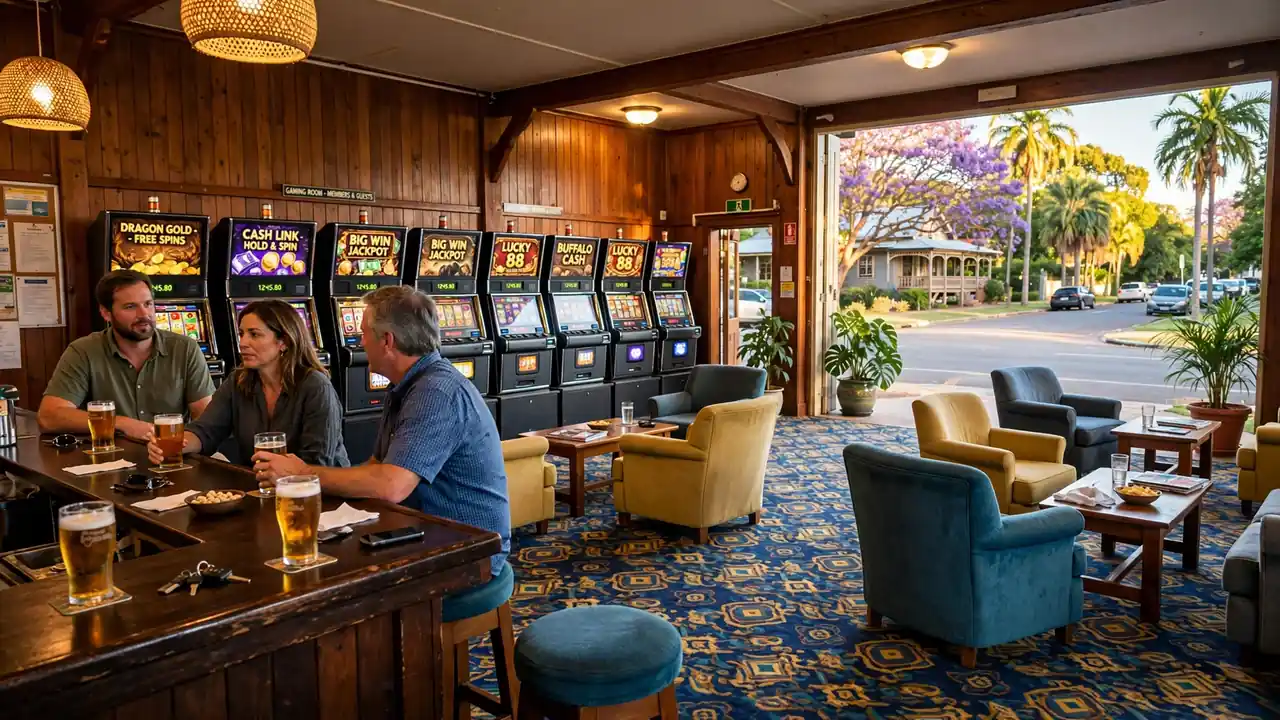
“Pokies” is the Australian term for electronic gaming machines, and the word belongs to the country’s social vocabulary as much as to its gambling industry. It evokes clubs, hotels and casinos rather than the abstract language of software. For many Australians, the machines are part of the ordinary landscape of local entertainment: bright screens, familiar sounds, loyalty systems and a quiet concentration that can make a crowded room feel strangely private.
Moving that experience online changes more than the setting. The physical limits of a venue disappear, as does the visible rhythm of entering, playing and leaving. A digital service can be available wherever an internet connection exists, which is precisely why online gambling has become the fastest-growing gambling segment. The concern is not simply that a particular game is popular. It is that the game’s availability can be detached from the social boundaries that once surrounded it.
The law therefore does not treat online pokies as a harmless extension of club gaming. When offered to an Australian customer through an online service, they are prohibited interactive gambling services. The familiar name does not soften the classification.
There is a cultural irony here. Australia has made room for pokies in parts of its land-based gambling economy while drawing a firm boundary around their online form. The same basic attraction—rapid play, visual rewards and repeated decisions—can be socially tolerated in one setting and prohibited in another. Regulation is often less a declaration that a game is good or bad than a decision about where, how and by whom it may be made available.
Roulette and blackjack are not exceptions
Roulette appears to offer a different kind of gambling story. Its wheel has a ritualised pace, its numbers are visible, and its table creates a shared scene rather than the solitary repetition associated with a machine. Blackjack, meanwhile, is often presented as a game of judgement and restraint, with the player apparently making decisions rather than simply waiting for a result.
Those differences matter culturally, but they do not create an online exemption. Roulette and blackjack are included among the casino games treated as prohibited interactive gambling services when offered online to Australian customers. A live interface, a streamed wheel or a digital dealer changes the presentation, not the legal position.
This is where casino language can become misleading. A website may divide its products into tables, slots and live rooms, giving each category its own mood and identity. The arrangement feels like a modern entertainment platform. Legally, however, the question is narrower: is the service offering an online casino game to an Australian customer? If so, the polished presentation cannot turn a prohibited service into a permitted one.
The result is a boundary that cuts across the usual distinctions between games. Skill, chance, speed and social atmosphere may shape the player’s experience, but they do not alter the basic classification supplied by the Interactive Gambling Act.
Live dealer tables and the theatre of legitimacy
Live dealer games deserve particular attention because they borrow so heavily from the language of legitimacy. A real person appears on screen. Cards are handled in real time. A wheel spins in a studio. There may be branded tables, formal greetings and a visual setting designed to resemble a casino floor. The service looks less like a piece of software and more like a remote window into an established institution.
That appearance is part of the product’s appeal—and part of its risk as a legal signal. A live dealer table is still an online casino service when supplied digitally to an Australian customer. The presence of a human dealer does not make it a land-based game, and the studio does not become an Australian venue by imitating one.

The theatre is convincing. The jurisdiction is not.
For regulators, the central issue is the provider’s conduct. The Interactive Gambling Act targets the provider rather than the individual player. Australians are not committing a crime merely by placing bets at offshore sites. That distinction matters because public discussion can otherwise become needlessly moralising, as though the law were designed to punish every person caught on the wrong side of a digital border. Its principal machinery is directed at services supplying prohibited gambling, not at treating the player as a criminal.
This does not make offshore play safe, approved or domestically licensed. It means only that legal responsibility is structured around the provider. Confusing those two points produces a particularly unhelpful kind of reassurance: one that removes criminal liability while leaving the practical and regulatory uncertainty intact.
A social boundary, not a catalogue
The games themselves are familiar enough that a catalogue would add little. Their importance lies in what they reveal about Australian regulation. Pokies represent the ordinary visibility of gambling in local institutions. Roulette and blackjack carry the ritual and prestige of the traditional casino. Live dealer tables translate that atmosphere into an online performance. Together, they show how easily a commercial service can make prohibition look like a matter of branding.
Yet the law is not persuaded by branding. The Interactive Gambling Act places these online services behind the legal line when they are offered to Australians. The line does not depend on whether the game is fast or slow, solitary or social, automated or hosted by a dealer. Nor does it disappear because the operator describes the product as entertainment.
That is why the casino label needs careful handling in an Australian context. It may describe a style of game, a visual language or a long-standing social institution. It does not establish that the online service is lawful for Australian customers.
The country’s approach is an uneasy compromise: gambling remains visible and culturally embedded, while certain digital forms are excluded. As online access grows, that distinction becomes harder to explain in everyday terms and more important to preserve in legal ones. The games have crossed into the digital world. The permission has not.
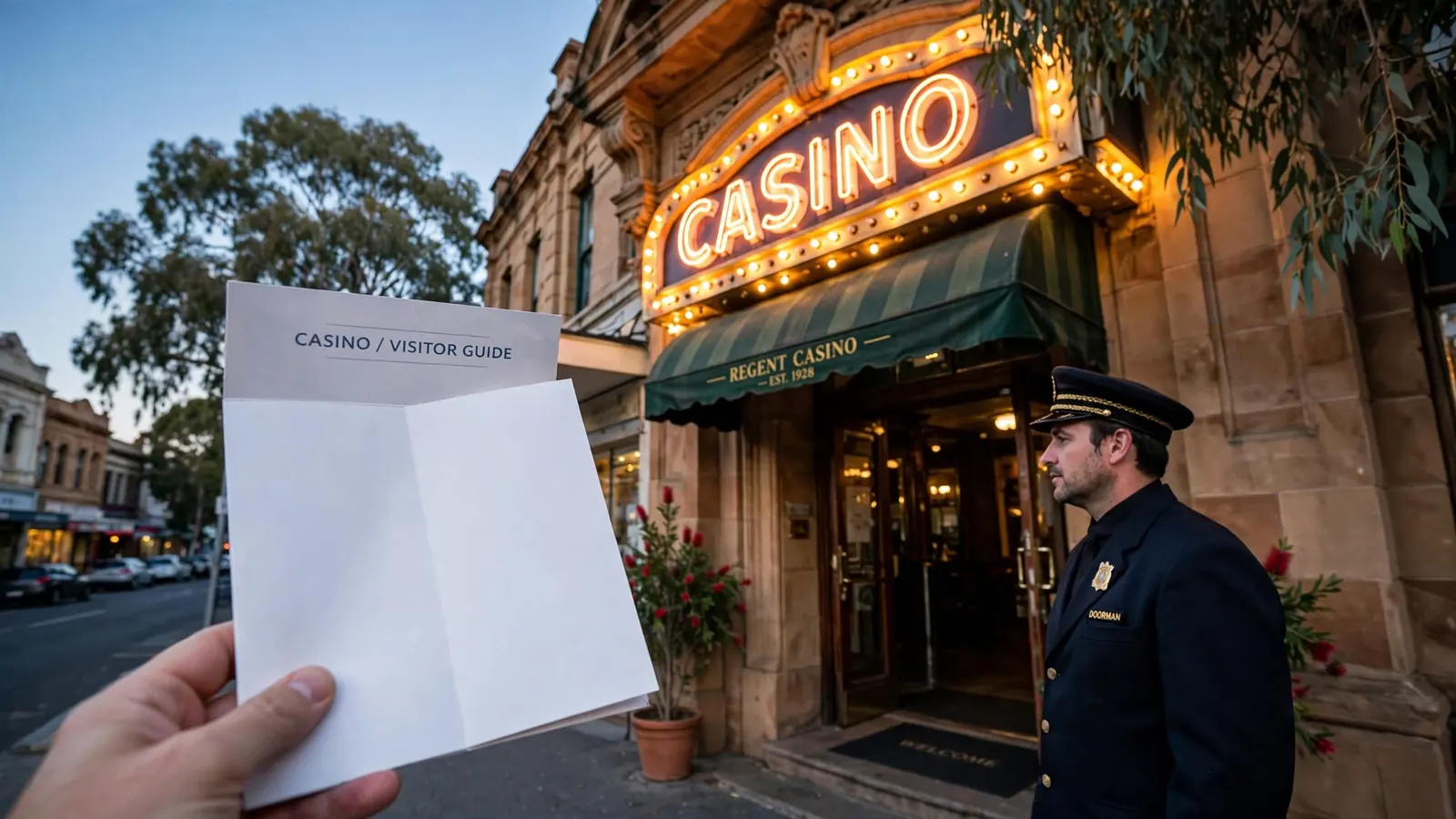
Bonuses, Promotions and the Economics of Prohibition
A bonus is never just a bonus. It is a commercial argument dressed as generosity: open an account, deposit funds, place a wager, return tomorrow. In a lawful market, such offers can be assessed alongside the product they promote. Australia’s online casino market has no such ordinary setting. Casino-style promotions cannot be separated from the prohibition on the underlying service.
The Interactive Gambling Act 2001 makes it illegal for gambling providers to offer certain online services to people in Australia. Online casino games fall within that boundary when supplied to an Australian customer. The consequence is important for advertising language: a welcome offer, deposit match, free spins package or loyalty reward cannot turn a prohibited service into a lawful Australian betting product.
The promotion follows the product. If the product is not authorised for local online supply, its inducement is not an ordinary Australian betting offer.
Why casino bonuses are different
Australian wagering is not one undivided commercial category. Licensed services may offer sports and race wagering under the relevant state, territory or federal arrangements. Casino-style inducements belong to a different regulatory context because they are designed to attract customers to an online casino service that has no domestic real-money licence.
That distinction is easy to lose in glossy promotional language. “Australian players welcome” may sound like a statement about geography rather than legality. “Local payment support” may sound like evidence of approval. Neither phrase supplies an Australian casino licence, and no Australian gambling licence exists for casino games because offering that product to Australians is against the law.
The commercial mechanism is familiar. A promotion lowers the apparent cost of starting, creates a reason to return and makes a site look established through badges, countdowns and carefully worded terms. But in a prohibited market those devices do not merely sell entertainment. They help a provider reach customers whom the domestic framework is intended to keep outside that service.
That is why a casino bonus should not be placed beside a lawful sports-betting offer as though both were routine products. The resemblance is commercial, not legal.
Inducements and the Australian boundary
Australian rules also restrict advertising inducements for betting accounts. Sign-up and first-deposit bonuses, free bets and refer-a-friend offers are not harmless editorial decoration when they encourage gambling activity. They are precisely the language through which a provider acquires and retains customers.
- Verify if the operator holds a relevant Australian state or territory wagering licence.
- Use the ACMA register to confirm legitimate interactive wagering service providers.
- Assume a foreign casino licence makes an online service legal in Australia.
- Treat offshore casino bonuses as equivalent to lawful Australian wagering offers.
For casino content, the problem is sharper. A promotional page may invite an Australian resident to register for a service that is itself prohibited. Publishing advertisements or links for prohibited or unlicensed interactive gambling services can provide a basis for website blocking. ACMA can direct internet service providers to block sites operating in breach of the Interactive Gambling Act.
The regulator’s enforcement record gives the restriction a physical shape. As of August 2025, ACMA had blocked 1,296 illegal sites and affiliates since 2019. More than 220 illegal gambling services had voluntarily exited the Australian market following ACMA action. Another account of the figures describes more than 220 online gambling services as having withdrawn from Australia since the reforms. The wording differs, but both versions describe the same broad commercial result: providers have not been treated as ordinary participants in the domestic market.
A promotion therefore carries more than a price incentive. It can be a signal that the provider is still seeking Australian customers despite the boundary.
The economics behind the prohibition
The restriction is often discussed as a question of legality, but it is also a question of market design. Promotions make gambling services easier to notice, easier to try and harder to treat as an occasional activity. They move attention from the uncertain outcome to the immediate reward: extra play, a matching amount, a loyalty status or a limited-time offer.
That structure matters because gambling losses are not distributed like the cost of an ordinary subscription. Australia reported approximately $32 billion in gambling losses during 2022–2023. A different source gives a lower figure of approximately $25 billion in annual losses on legal forms of gambling. These figures are not interchangeable: they appear to use different definitions and coverage. The disagreement itself is a reminder that a headline loss figure needs a stated scope.
The same caution applies to harm estimates. A profile-style industry review gives problem-gambling prevalence as between 0.5% and 1.0%, with a further 1.4%–2.1% described as at risk of developing problems. That is one source’s framing, not an established market norm, and the categories do not describe the same population. Promotions should not be judged only by the number of people who accept them; their design also matters for people already at risk of losing control.

A bonus can make a transaction feel like an opportunity rather than a cost. The arithmetic may be printed in small type, while the emotional message stands in large type. Dryly put: the free part does the advertising.
Restriction changes the promotional market
When a service is prohibited, conventional consumer signals become less reliable. A foreign licence may demonstrate that an offshore operator is regulated somewhere else, but it does not authorise casino games for Australian customers. A polished brand, an Australian flag in the marketing or a local-sounding promotion cannot supply the missing domestic permission.
The market response has been visible in enforcement. Reports show that the amount of money people lost on gambling services based outside Australia has reduced since the reforms. That does not mean the risk has disappeared, nor does it make every remaining promotional claim credible. It suggests that blocking, withdrawals and public warnings can alter the flow of customers and money even when the demand for gambling remains.
Legal Distinction The Australian market has a licensed online wagering lane, but no equivalent domestic online-casino lane.
The commercial incentive to advertise does not vanish simply because the legal route is closed. It moves into comparison pages, affiliate content, social media language and promotional explanations that present a foreign service as if it were an Australian option. The wording may avoid a direct claim of legality. The practical invitation can remain unmistakable.
For that reason, responsible discussion must describe the legal boundary before discussing the attraction of any offer. It should not reproduce bonus codes, registration links or calls to action for offshore casinos. Nor should it frame foreign promotions as substitutes for licensed Australian wagering. That would convert explanation into facilitation.
What a promotion cannot prove
A casino promotion cannot prove that:
- the service holds an Australian gambling licence;
- ACMA has approved or endorsed the operator;
- the underlying online casino service is lawful for Australian customers;
- a foreign licence authorises service in Australia;
- advertised terms will resolve every dispute about withdrawals or account restrictions.
The proper conclusion is narrower and less exciting. Australian casino-style bonuses are commercial inducements attached to a prohibited online service, not ordinary locally licensed betting offers. Their apparent generosity does not alter the legal status of the product, and their presence may be one reason the service attracts regulatory attention.
The economics are plain enough: promotions buy attention, attention buys registrations, and registrations create exposure to loss. In Australia, the law has chosen to place the online casino business outside the domestic licence structure. The bonus cannot negotiate that decision away.
Payments and Withdrawals Without a Domestic Online Casino
Money behaves differently when the product at the other end of a transaction is not licensed domestically. Australia has no domestically licensed real-money online casino for Australian players. That single fact changes the meaning of every deposit, withdrawal and account balance associated with an offshore casino.
In a regulated local wagering market, payment infrastructure sits alongside licensing, dispute processes and responsible-gambling controls. The customer is not merely transferring funds to a website; the transaction forms part of a system supervised through the relevant legal channels. Online casino games do not have that Australian framework. There is no domestic casino licence to anchor the transaction, no local casino register to confirm the service, and no Australian licensing regime that turns a casino deposit into an ordinary local gambling payment.
The absence is practical, not decorative.
A deposit does not create a lawful local service
A payment page can look reassuringly familiar. It may display bank-transfer instructions, an electronic-wallet option or a branded checkout screen. None of those features supplies an Australian casino licence. Payment technology is not permission.
The Interactive Gambling Act 2001 places the legal burden on the provider rather than the player. Australians are not committing a crime merely by placing bets at offshore sites. That distinction matters, but it should not be mistaken for consumer protection. A player may not be the person targeted by the prohibition, while still being the person left to absorb the consequences when a transaction fails, an account is closed or a balance becomes inaccessible.

A successful deposit proves only that money moved. It does not prove that the service is authorised to offer online casino games in Australia, that the account will remain available, or that a dispute will be handled through an Australian gambling regulator.
That is the unglamorous heart of the matter.
Withdrawals carry the same uncertainty
The language of withdrawals often suggests a neat reversal: funds go in, winnings come out. Without a domestic online casino, the legal and commercial relationship is less settled. A withdrawal can involve identity checks, payment-provider decisions, account restrictions or the operator’s own policies. The important point is not that every offshore transaction fails. It is that the Australian legal structure does not convert an offshore casino into a locally supervised financial service.
When a domestic betting operator is licensed for lawful wagering, its position can be considered alongside the relevant state or territory framework. An offshore casino offering prohibited interactive gambling services has no equivalent Australian casino licence. The presence of a foreign licence does not change that position. A Malta or Curacao licence may describe the operator’s status in another jurisdiction, but it does not authorise online casino games for Australian customers under Australian law.
This makes the apparent simplicity of a payment screen rather misleading. The money may be denominated in Australian dollars; the legal relationship is still offshore.
Why blocked websites matter to payments
ACMA’s enforcement activity shows how unstable this environment can become. As of March 2026, ACMA had directed internet service providers to block 1,564 illegal gambling and affiliate websites. Another reported figure says ACMA had blocked 1,296 illegal sites and affiliates since 2019, as of August 2025. These figures come from different reporting points and are not interchangeable; the discrepancy should be stated rather than quietly resolved.
More than 220 online gambling services have withdrawn from the Australian market since the reforms. A separate formulation describes more than 220 illegal gambling services as having voluntarily exited following ACMA action. Again, the wording and reference point differ, although both accounts indicate substantial market retreat.
For payments, the consequence is straightforward: access can change after money has been deposited. A blocked domain may no longer load through ordinary internet access. A service may stop accepting Australian customers. An operator may leave the market. None of these developments automatically determines what happens to an individual balance, but each can make the route to clarification more difficult.
The website disappearing is not a payment method.
The wider financial picture
Online gambling is the fastest-growing gambling segment, which helps explain why payment access has become part of the regulatory argument rather than a minor technical detail. Digital transactions make gambling available across the day and detach the act of spending from the physical setting that once gave it a visible boundary. A transfer can look like any other online purchase until the underlying service becomes unavailable.
Reports indicate that the amount Australians lost on gambling services based outside Australia has reduced since the reforms. That suggests enforcement and market withdrawal have had a measurable effect, even though restriction does not eliminate gambling demand. The legal system is trying to narrow the commercial channels, not pretend that desire disappears when a domain is blocked.
Reported national loss figures also vary. Australia recorded approximately $32 billion in gambling losses during 2022–2023, while another figure places Australians’ losses on legal forms of gambling at approximately $25 billion each year. These are not necessarily like-for-like measures: they refer to different periods and categories. Treating them as one settled total would create false precision.
The scale is still clear. Payment friction is not an abstract inconvenience when gambling losses are measured in billions.
Credit, cards and digital confidence
Australia’s restrictions also mean that payment discussions require care. Credit cards and cryptocurrency must not be promoted as deposit methods for Australian online gambling; both have been banned since 11 June 2024. Nor should credit-funded payment methods be presented as a solution to an offshore casino’s absence of domestic status.
The broader principle is simple: a familiar financial instrument does not make a prohibited gambling product lawful. A card logo, a digital wallet or a bank-transfer option can create the visual language of an ordinary online purchase. Regulation is less impressed by visual language.
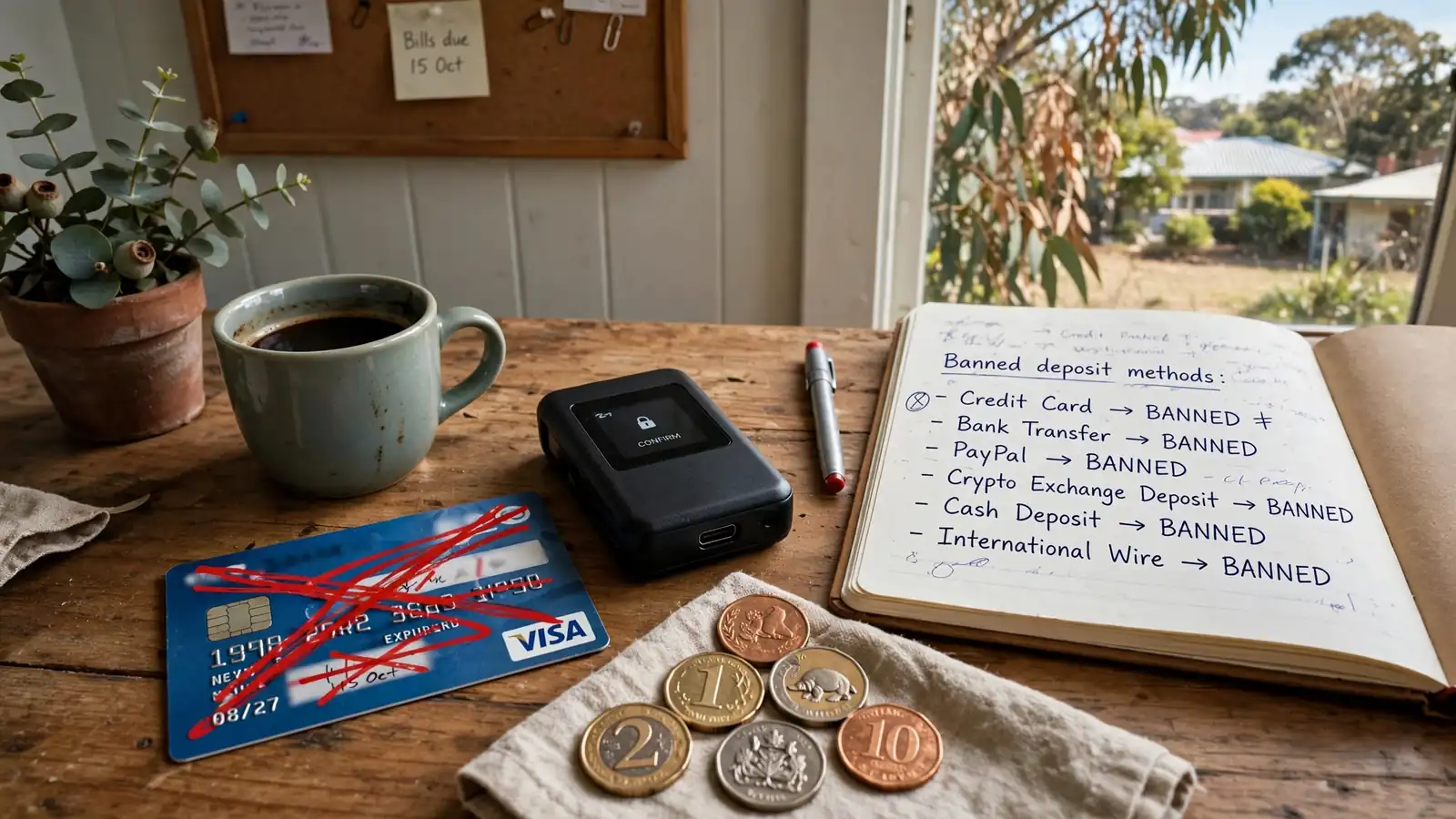
There is also a human cost to treating payment access as merely convenient. When funds are transferred into an offshore gambling account, the boundary between available money and committed money can become less visible. If the service is blocked or exits Australia, uncertainty may arrive after the spending decision rather than before it. That is why responsible-gambling support belongs in any honest discussion of payments. BetStop – the National Self-Exclusion Register™ and Gambling Help Online provide Australian support pathways; neither is a licence for an online casino, and neither makes prohibited services domestic.
What the absence means in practice
Without a domestic online casino, there is no locally licensed payment journey for real-money casino play to recommend. There are only the consequences of sending money toward a service operating outside that Australian framework:
- a foreign licence is not an Australian casino licence;
- a successful deposit does not confirm lawful domestic authorisation;
- a withdrawal is not guaranteed by Australian casino regulation;
- website blocking or market withdrawal can affect access to an account;
- payment technology cannot replace licensing;
- the player is not criminalised by the Interactive Gambling Act merely for placing a bet offshore, but that does not remove financial or consumer risk.
This is why “payments and withdrawals” cannot be treated as a shopping list of methods. In Australia, the decisive question comes earlier: what legal structure, if any, stands behind the transaction? For online casino games, there is no domestic real-money licence standing there.
How to Read Casino Comparisons and Check a Licence
A casino comparison aimed at Australians has to be read against an awkward legal map. The word “licensed” does not answer the important question by itself. A licence may exist, be current, and be genuine, yet still not authorise an online casino to serve people in Australia.
The first distinction is between a domestic wagering licence and a foreign casino licence. Australian-licensed operators may offer permitted gambling products, including sports and race wagering, under the relevant local arrangements. That does not create an Australian licence for online casino games. No domestically licensed real-money online casino exists for Australian players.
Checking a Licence
- Confirm if the product is sports or race wagering rather than casino games.
- Identify the specific legal entity named on the licence.
- Verify the licence number via the official regulator’s public register.
- Check if the licence is domestic (Australian) or foreign.
- Ensure the licence scope actually covers the specific product being offered.
That boundary should come before any discussion of reputation, banking, games or customer service. Otherwise a comparison can make an offshore casino look like an ordinary local betting service simply by placing a foreign badge beside an Australian flag. Presentation is not jurisdiction.
Start with the product, not the badge
A guide may use “casino” as a broad commercial label while describing several different services. The legal position depends on what the operator actually offers.
A site comparing sports bookmakers is dealing with a category for which Australian licences exist. A page describing online pokies, roulette, blackjack or live dealer tables is dealing with services that cannot be offered lawfully to Australian customers under an Australian gambling licence. The same operator may hold a foreign licence, but that foreign authorisation does not turn the prohibited product into a domestically licensed service.
This makes the first checking question simple:
- Is the comparison about sports or race wagering?
- Or is it presenting casino games as available to Australians?
If the second description fits, the page should not be read as a list of Australian-licensed options. It is describing offshore casinos, and the foreign licence must be treated as foreign.
A polished comparison can obscure this distinction. Terms such as “regulated”, “secure” and “licensed” may all be technically defensible in a narrow sense while leaving the central Australian question unanswered. The missing phrase is often the decisive one: licensed where, and authorised to provide what?
What an Australian register can prove
ACMA publishes a register of Australian-licensed interactive wagering service providers. This is the appropriate starting point when a guide makes a claim about an Australian wagering licence.
The register can help establish whether a named service provider appears among Australian-licensed interactive wagering providers. It cannot be used to manufacture a domestic licence for a casino product that Australian law does not permit. A listing connected with wagering does not automatically cover online casino games, and a company’s presence in one regulated category does not grant permission in another.
The register is therefore evidence with a limited purpose. It can support a claim about Australian-licensed wagering. It cannot support the claim that an online casino is Australian-licensed merely because the company, brand or corporate group has some local connection.
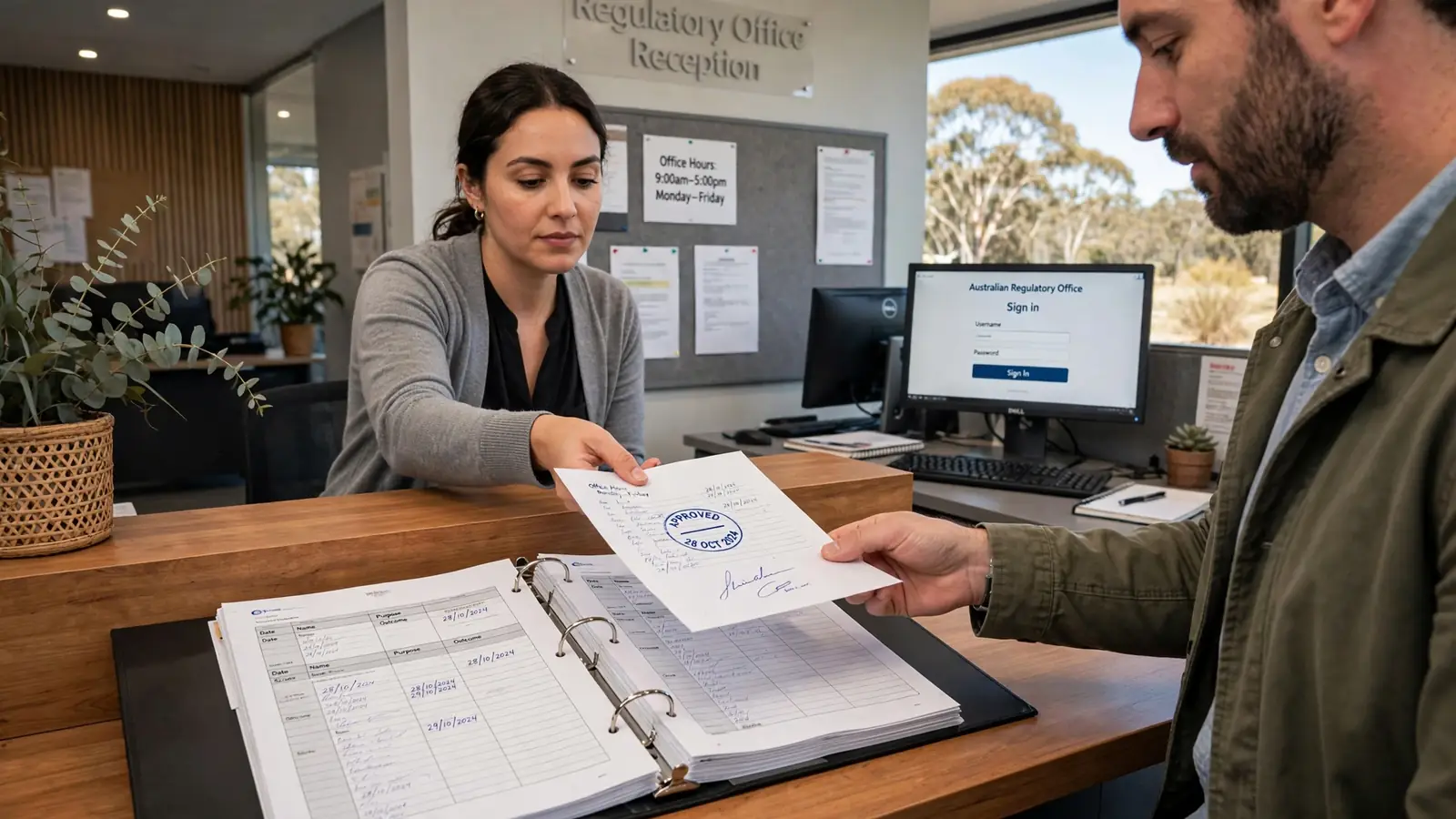
Queensland illustrates why broad claims need careful wording. There is no current holder of an interactive gambling licence in Queensland, while UBET QLD Limited is the exclusive licence holder for race and sports wagering there. Those statements concern different regulatory categories. Folding them into one sentence about “Queensland casino licensing” would create a conclusion that the facts do not support.
A comparison should also identify the legal entity named on a licence, rather than relying only on a familiar brand. Brands, parent companies and operating entities are not interchangeable. If the licence number belongs to a different entity, the guide has not yet shown that the claimed authorisation belongs to the service being described.
How to check a foreign licence
Offshore operators commonly hold licences from Malta or Curacao rather than an Australian casino licence. Such a licence can be checked through the public register maintained by the relevant foreign authority.
The process is documentary rather than decorative:
- Find the exact legal entity and licence number stated in the comparison or on the operator’s own legal page.
- Open the regulator’s official website, not a badge supplied by the operator or repeated by an affiliate.
- Search the public register for the licence number or legal entity.
- Confirm that the status is current and that the registered entity matches the service being described.
- Check the scope of the authorisation instead of stopping at the word “active”.
- Record the jurisdiction separately from the question of whether Australians may lawfully be served.
The Malta Gaming Authority and Curacao eGaming maintain public registers where a licence number and its status can be checked. The result answers whether the foreign authority recognises the licence. It does not answer whether Australian law permits the operator to provide online casino games to Australian residents.
That second question cannot be outsourced to a foreign regulator. A Maltese or Curacao licence is not an Australian casino licence. It is not a substitute for one, and it should never be presented as if it were.
Warning signs in comparison pages
Some wording deserves immediate suspicion because it blends unlike forms of authorisation:
- “Australian licensed casino” supported only by a Malta or Curacao licence.
- “ACMA approved” or “ACMA licensed” without evidence from the Australian register.
- A local wagering licence used to legitimise online pokies or table games.
- A licence badge with no number, legal entity or regulator’s register.
- A comparison that cites an operator’s own claims but omits the regulator.
- A statement that a casino is “legal for Australians” based solely on its foreign registration.
- A familiar Australian brand presented without identifying the entity that holds the relevant licence.
The ACMA is the regulator responsible for monitoring compliance with and enforcing Australia’s interactive gambling laws. That does not make ACMA an approval stamp for every service appearing in a guide. A comparison that uses the regulator’s name as a marketing ornament is doing the reader no favour.
The same caution applies to lists of supposedly “trusted” or “safe” sites. Trust is not a legal category. A guide may discuss corporate transparency or the existence of a foreign registration, but it should not translate those points into a claim of Australian authorisation.
A better comparison framework
A responsible comparison separates facts into distinct columns, even when the published page does not use a table:
| Question | What it establishes |
|---|---|
| What product is offered? | Whether the page concerns wagering or online casino games |
| Which legal entity operates it? | Who is actually responsible for the service |
| Which regulator is named? | The jurisdiction behind the licence claim |
| What is the licence number? | Whether the claim can be checked |
| Is the entity in the official register? | Whether the stated regulator recognises it |
| Is the licence Australian or foreign? | The legal geography of the authorisation |
| Does the licence cover this product? | Whether the badge applies to the service described |
This structure prevents a common editorial shortcut: treating a genuine foreign licence as proof of Australian legality. It also keeps a comparison from confusing the existence of regulation with the right to serve a particular market.
One market statistic should be handled with similar care. A profile-style industry review gives the Australian market approximately 130 licensed operators as of 16 September 2026. That figure should be attributed to that type of source, not presented as a timeless official count. Even a number that sounds precise can describe a changing category, a chosen definition of “operator”, or a particular date.
The habit matters. Licensing claims should be dated and sourced; figures should be dated and sourced; commercial praise should not be allowed to impersonate either.
A sound comparison is therefore less like a league table and more like a paper trail. It identifies the product, the entity, the regulator, the register and the limits of the licence. If those pieces do not line up, the neatest badge on the page cannot repair the gap.
No badge can do that.
Prepared by the Casino Info Au editorial staff.